
Isle of Wight Property Tax Record Fields
Isle of Wight property tax records keep assessment and billing in separate hands. The Commissioner of the Revenue runs the real-estate assessment search. Its own notice warns that data may be incomplete. The Treasurer's Paybill portal handles charges and payments. No single page displays every field. Confirm each item at the office that keeps the figure you need.
| Field | What It Shows | Where |
|---|---|---|
| Assessment | County value used in the local real-estate assessment record | Commissioner of the Revenue |
| Property history and improvements | Categories the Commissioner portal advertises | Public Access portal |
| Bill type and payment | Payment path, amount entered, and confirmation | Treasurer Paybill |
| Current or delinquent tax | Account status, penalty, and interest questions | Treasurer contact |
| Recorded tax lien | Separate instrument or lien record, if recorded | Circuit Court Clerk |
The Commissioner sets each parcel's real-estate assessment. The Treasurer's bill shows the charge and payment status. A deed's consideration records what a transaction stated, while market value is an appraisal concept. The figures can differ because they measure different things, often on different dates.
Isle of Wight Commissioner and Treasurer
The office split comes first. The Commissioner of the Revenue answers for assessments. Its Public Access portal supports property assessment lookups under Virginia Code §58.1-3122.2. The landing page lists property history, improvement information, and a map link. It also warns that displayed data is not guaranteed accurate.
The Treasurer collects the bills. The county payment portal is not a full tax-roll search, so a parcel result never proves the balance is clear. Call the Treasurer at 757-365-6228, weekdays from 9 a.m. to 5 p.m. Assessment corrections go to the Commissioner. The Treasurer cannot change a valuation record.
The Commissioner Property Search page holds the official instructions for looking up an address, owner, and Parcel ID in the assessment search.
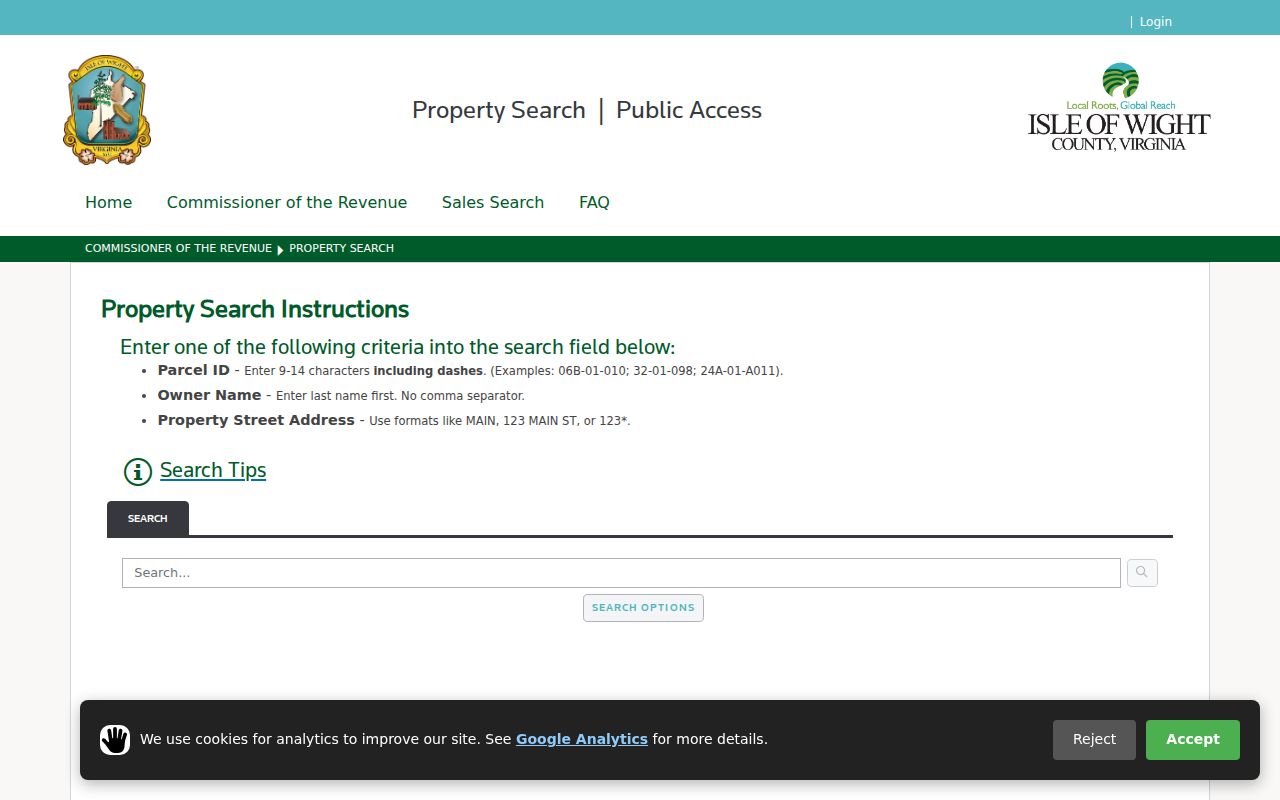
For an account balance, keep going to the Treasurer.
Paying an Isle of Wight Tax Bill
The Treasurer's online service walks a payer through fixed choices. It does not promise a search by street address. Keep the Isle of Wight account number handy. Compare the bill type and amount before paying. Save the confirmation number in case a question later turns on whether a payment arrived.
- Select the bill type and choose a payment type.
- Enter the Isle of Wight account number and the amount to pay.
- Review each entry, then confirm the payment details.
- Keep the confirmation number and contact the Treasurer if the account does not reflect the transaction.
- Assessment
- The value set in the county property record for local taxation.
- Tax bill
- The Treasurer's account charge and payment record.
- Delinquency
- An unpaid account status; confirm the current balance with the Treasurer.
- Tax lien
- A recorded claim related to unpaid tax; check with the Treasurer and Clerk.
The Isle of Wight Paybill service lists Real Estate Property Payment, credit card, and electronic funds transfer choices. Each entry gets verified before the payment submits.
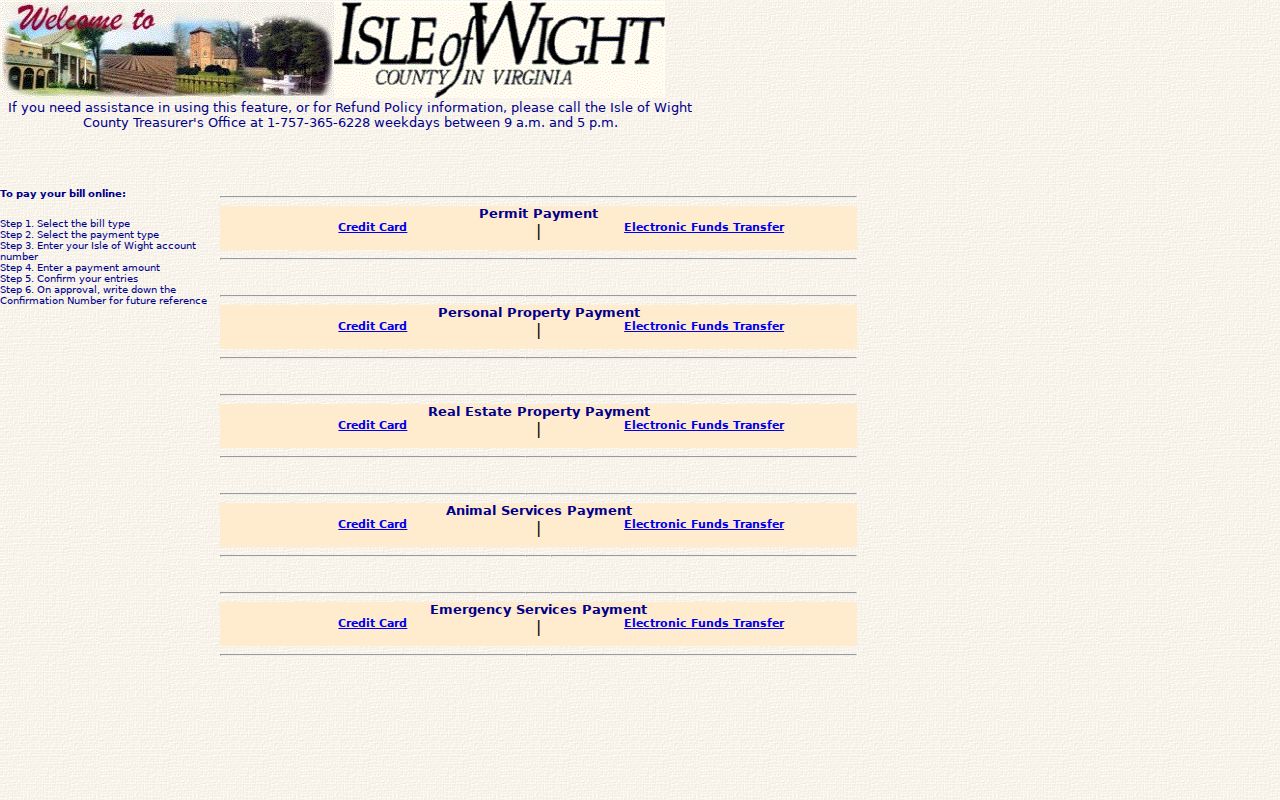
Processor fees and current due dates are not posted in advance. Check the live service or ask the Treasurer before relying on any total.
Isle of Wight Assessment Dates
Virginia Code §15.2-619 sets a January 1 assessment date. Real estate is valued as of that day each year under the county form the provision addresses. The statute also caps reassessment intervals. Notice timing is regulated there as well. That county-manager model may not fit Isle of Wight in every detail, though, so the current county notice or the Commissioner is the safer guide before any date becomes a local calendar.
The distinction matters when a sale enters the picture. A transaction can close months after the assessment date. The roll may not refresh when a new deed appears. Isle of Wight publishes no standard deed-to-roll lag. After a recent transfer, compare the latest recorded instrument with the current assessment, and ask the Commissioner when the roll has not caught up.
Isle of Wight Delinquent Tax Records
The county budget splits current real-estate taxes from delinquent ones. Penalty and interest get their own lines. The Paybill page is a payment tool. It posts no delinquent-account list and no tax-sale notices. The county offers no online delinquent search. For a live balance, ask the Treasurer. Do not trust a third-party notice or an old screenshot.
A tax lien or sale instrument can end up recorded. Once recorded, it lives in the Circuit Court Clerk's land records. That search is a separate step. The Treasurer can explain the account amount and where payment stands. The Clerk confirms what the record holds. A paid balance and a recorded release are different evidence. Keep the two questions apart when a title or parcel issue depends on them.
When you call about a delinquent account, give the Treasurer the parcel or account number. Include the tax year. Ask for the current amount due. That total may include penalty and interest. Whether a lien sits in the record is a separate question for the Clerk. The online payment route posts no tax-sale list, so confirm any notice with the County.
Correcting an Isle of Wight Assessment
The county's assessment portal carries a caution. It warns that online data may be incomplete. It directs corrections to the Commissioner of the Revenue, reachable at 757-365-6219. Have the address and Parcel ID ready. Explain which field looks wrong, and ask what documents the office needs. Public display of assessment data rests on §58.1-3122.2.
Virginia Tax guidance sends taxpayers to the local assessing official for corrections under §§58.1-3980 through 3983. A local real-property assessment appeal is not an appeal to the State Tax Commissioner. Code §15.2-619 sketches another route. That model describes a continuing local equalization board with an April 1 application deadline. It also sets notice, hearing, and decision rules. Ask the Commissioner whether Isle of Wight uses that board route. Ask what calendar it follows.
Isle of Wight Exemption Questions
The Commissioner's portal covers assessment records, property history, and improvements. It posts no local exemption list, application form, eligibility categories, or filing dates. Never assume relief appears automatically. A neighbor's account treatment does not transfer. Ask the Commissioner which relief programs the office currently offers and what supporting information an applicant must submit.
For an exemption already on an account, confirm the property, owner, effective year, and qualifying record with the Commissioner. Billing is a different custodian. Questions about a paid bill or a remaining balance go to the Treasurer instead. Use 757-365-6219 for assessment questions. The Treasurer's payment portal gives 757-365-6228 for account help. Exemption records and billing records answer to different offices.
File any determination with the parcel documents and note the year it covers. A tax-account change does not amend a deed, parcel boundary, or recorded lien.
Appeal an Isle of Wight Assessment
Start with the Commissioner's correction process. Pull the assessment notice issued for the property too. If a formal appeal is available, use the county's current form, filing location, and deadline. Virginia Code §15.2-619 sets an April 1 application date for the statutory county-manager model. It also describes notice, hearing, and decision rules. Confirm with the Commissioner whether Isle of Wight follows that exact provision and calendar.
Keep the parcel ID, notice, and deed reference together. Add any documents that explain the factual error. Ask which evidence the office accepts and whether a local review board is the next step. State guidance keeps corrections and appeals with the local assessing official and board, not the State Tax Commissioner.
Appeal window. Do not rely on the April 1 date without confirming the current Isle of Wight notice and procedure. The cited statute gives that date for a specific county model, and local application details need confirmation.